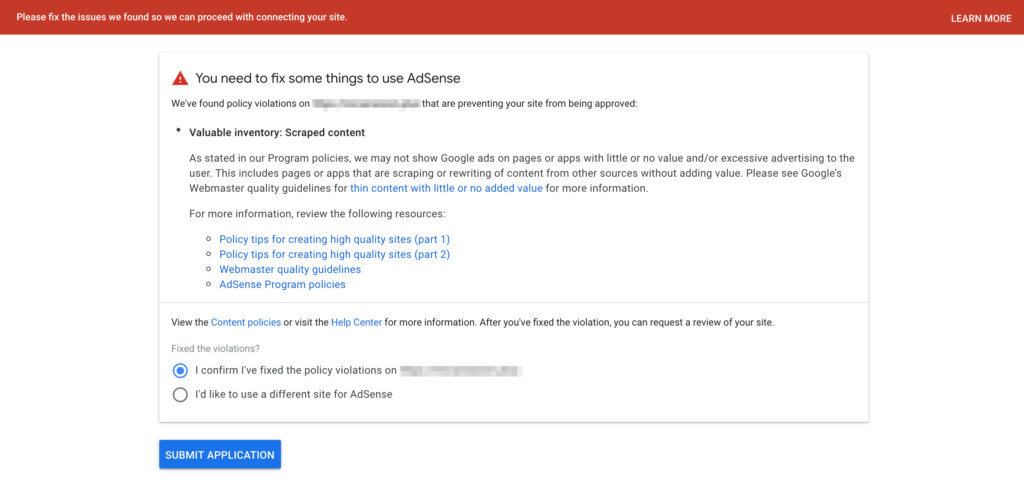

The second rejection hit different than the first. The first time, I figured I just didn’t know what I was doing yet, which was fair, because I really didn’t. The second time, I’d genuinely tried to fix things, and it still came back rejected with the same generic message. That one stung more, because I thought I’d already done the work.
I sat on that second rejection for almost a week without touching the site at all. Not out of laziness, more out of not knowing what else there was to even change. Eventually I went back through everything, slower this time, and ended up learning a handful of things that had nothing to do with technical steps and everything to do with how I was approaching the whole process.
This isn’t really a checklist post. It’s more just the actual lessons, the ones that changed how I thought about this rather than just what I clicked or edited.
Lesson 1: A Rejection Email Tells You Almost Nothing, and That’s Okay
Both my rejection emails said some version of “content doesn’t meet our standards,” with zero specifics. My first instinct both times was to treat that vague sentence like a puzzle I needed to solve exactly.
What actually helped was accepting that the email wasn’t going to hand me a fix, and that I needed to go find the actual problem myself instead of trying to decode a single vague sentence. Once I stopped rereading the rejection email for hidden meaning and just started auditing my own site honestly, things moved faster.
Lesson 2: “I Already Fixed That” Doesn’t Mean You Actually Fixed It
Between my first and second attempt, I told myself I’d improved my content. What I’d actually done was add two new posts and tweak a few headlines. The core problem — most of my articles being short and pretty surface-level — was still sitting there completely untouched.
It’s easy to feel like you’ve made real progress just because you did something. I had to go back and genuinely reread my weakest posts, the ones I’d been avoiding looking at closely, and admit that a couple new additions hadn’t fixed the underlying issue at all.
What actually changed between rejection two and my eventual approval: I rewrote five of my oldest, thinnest posts from scratch — not edited, rewritten — going from around 350 words each to 800-900+, with actual detail and my own take instead of generic points anyone could’ve written.
Lesson 3: The Boring Pages Matter More Than They Seem Like They Should
I skipped my About, Contact, and Privacy Policy pages on both rejected attempts, mostly because they felt like formalities that had nothing to do with “real content.”
When I finally sat down and wrote them properly — a real paragraph about who I was and why the site existed, a working contact form I actually tested by sending myself a message, and a Privacy Policy from a free generator (PrivacyPolicies.com) that I edited to actually reflect my site — it took under an hour total.
I can’t prove definitively this was the deciding factor, but it’s one of the clearest differences between my rejected site and my approved one, and it was also one of the easiest things to fix, which made ignoring it for two rounds feel a little silly in hindsight.
Lesson 4: Traffic From Friends and Family Isn’t the Same as Real Traffic
On my first two attempts, a good chunk of my visits came from links I’d shared directly — a few WhatsApp groups, a couple of Facebook posts asking people to “check out my new blog.”
That traffic is real in the sense that people did click, but it’s not really telling anyone anything about whether the content is useful on its own. Nobody found those posts because they were searching for an answer; they found them because I personally asked them to look.
For my approved attempt, I stopped doing this and instead focused on writing content that could actually show up in search results, then let that traffic build slowly and naturally. It was a smaller number overall, but it felt like a completely different kind of signal.
Lesson 5: Impatience Cost Me More Time Than Patience Would Have
Both of my rejections happened on sites I’d applied to almost immediately after finishing them. I was excited, the site felt done, so I applied.
Looking back, if I’d just waited two or three weeks after finishing the content — enough time to submit a sitemap through Google Search Console and let things get indexed — I might have avoided at least one of those rejections entirely. Instead, my impatience probably added weeks to the overall process, since each rejection meant going back, fixing things, and starting the review clock over again.
Lesson 6: Comparing Your Site to a Stranger’s Isn’t That Useful
I spent a fair amount of time between rejections looking at other approved sites, trying to reverse-engineer exactly what they’d done differently. Some had way more posts than me. Some had way less. Some looked polished, some looked pretty rough honestly.
That comparison mostly just made me anxious without giving me anything actionable. What actually helped was turning that same scrutiny on my own site instead — rereading my own posts as a stranger would, checking my own pages for the same gaps I was hunting for in other people’s sites.
Step-by-Step: What I’d Actually Recommend After Two Rejections
If you’re sitting on two rejections right now, here’s the order I’d go through, based on what actually moved things forward for me:
- Stop rereading the rejection email for clues. It’s not going to tell you more than it already has.
- Reread your weakest articles honestly, not the ones you’re proud of. Rewrite anything that feels thin or generic.
- Add real About, Contact, and Privacy Policy pages if you haven’t already — don’t leave them as an afterthought.
- Check where your traffic is actually coming from. Shift focus toward organic search traffic instead of shared links.
- Submit your sitemap through Google Search Console and give the site real time — at least two weeks — before applying again.
- Resist the urge to compare your site to random approved examples online. Focus that energy on your own content instead.
Common Mistakes I Made Across Both Rejections
- Assuming small tweaks counted as real fixes, when the core issues were still there.
- Skipping the standard pages because they didn’t feel like “real” content work.
- Relying on shared links for traffic instead of letting organic search build up.
- Reapplying too quickly, without giving the site real time to reflect any changes.
- Spending more energy comparing myself to other sites than actually fixing my own.
Final Thoughts
Two rejections felt like a lot at the time, though I know plenty of people have gone through more than that. What actually shifted things wasn’t some clever discovery, it was slowing down enough to be honest about what I’d actually fixed versus what I just assumed I’d fixed.
If you’re in that same spot right now, sitting on a couple of rejections and feeling stuck, it’s probably worth going back through your site with a lot more honesty than the first time around. Chances are the real issue isn’t hidden or complicated, it’s just something you’ve been half-fixing instead of actually fixing.