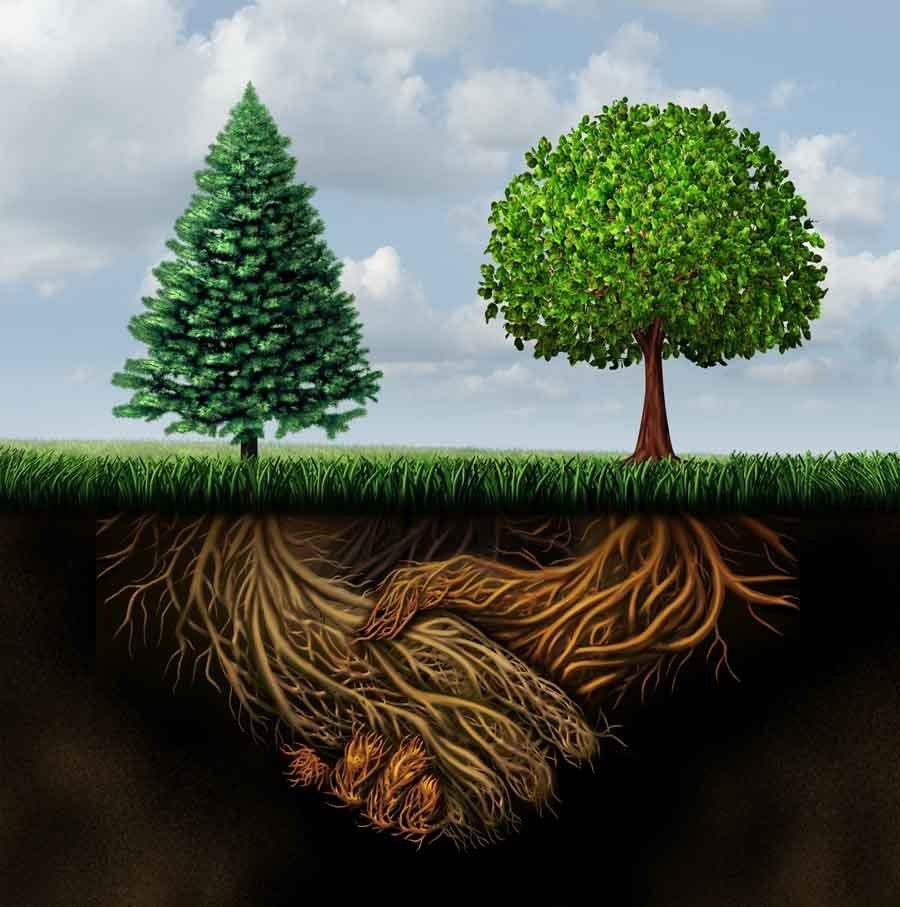
Plants are often thought of as silent and passive organisms, but modern biological research shows that plants are highly interactive living systems that communicate through chemical signals, root networks, and airborne compounds, allowing them to respond to threats, share resources, and coordinate survival strategies in ways that resemble a hidden language of nature, making forests not just collections of trees but interconnected biological communication systems.
🌿 How Plants Communicate Without a Brain
Unlike animals, plants do not have a nervous system or brain, but they still process environmental information and respond intelligently through biochemical signaling, where cells release chemical compounds that travel through air, soil, or water to send messages to other parts of the plant or nearby plants, allowing coordinated responses to stress, damage, or environmental changes.
This communication is slow compared to animal nervous systems, but highly effective for long-term survival.
🌳 Chemical Signaling: The Airborne Language of Plants
Plants release volatile organic compounds (VOCs) into the air when they are under attack by insects or pathogens, and these chemicals act as warning signals to nearby plants, triggering defensive responses such as toxin production, leaf thickening, or reduced nutritional value to discourage herbivores.
This airborne signaling system allows plants to “warn” each other about danger without physical contact.
🌱 Root Communication and Underground Networks
Beneath the soil, plant roots interact with fungal networks known as mycorrhizae, forming complex underground communication systems where nutrients, water, and chemical signals are exchanged between plants, and this network is often called the “Wood Wide Web” because it functions like a biological internet connecting trees and plants in a shared survival system.
Through this system, plants can support weaker neighbors or detect environmental stress signals from other plants.
🍃 Defense Mechanisms Triggered by Communication
When plants detect danger through chemical signals, they activate defense mechanisms such as producing bitter compounds, toxins, or thick protective layers to reduce herbivore damage, and some plants even increase nectar production to attract predator insects that attack herbivores, creating indirect defense strategies through ecological interactions.
This shows that plant communication is closely linked to survival behavior.
🌿 Plant-to-Plant Cooperation and Resource Sharing
In some ecosystems, especially forests, plants share nutrients and carbon through root-fungal networks, allowing older or stronger trees to support younger or weaker ones, and this resource sharing improves ecosystem stability and helps forests survive environmental stress such as droughts or disease outbreaks.
This cooperation challenges the idea that nature is purely competitive.
🌞 Light, Gravity & Environmental Sensing
Plants also respond to environmental signals such as light (phototropism), gravity (gravitropism), and water availability (hydrotropism), allowing them to grow in optimal directions for survival, and these responses are controlled by hormones like auxins that regulate growth patterns based on environmental feedback.
This makes plant behavior highly adaptive even without conscious decision-making.
🧠 Intelligence Without a Brain
Although plants do not have brains, their communication systems create behavior patterns that resemble distributed intelligence, where many small signals combine to produce coordinated responses at the organism and ecosystem level, allowing plants to adapt to complex environments over long time scales.
This challenges traditional definitions of intelligence in biology.
🌍 Ecological Importance of Plant Communication
Plant communication helps maintain ecosystem balance by regulating herbivore populations, supporting biodiversity, and improving resilience against environmental stress, and when plants coordinate defenses and resource sharing, entire ecosystems become more stable and resistant to collapse.
⚠️ Disruption of Plant Communication by Humans
Human activities such as deforestation, pollution, soil degradation, and climate change disrupt plant communication systems by breaking underground fungal networks and altering chemical signaling processes, which weakens ecosystem stability and reduces forest resilience.
🧬 Scientific Importance and Future Research
Scientists are studying plant communication to develop sustainable agriculture systems, improve crop resistance to pests, and understand ecosystem dynamics, and this research may lead to farming methods that reduce chemical pesticide use by enhancing natural plant defense systems.
🌱 Conclusion
Plant communication systems reveal that forests are not silent or passive environments but active, interconnected networks where plants share information, resources, and defense strategies, creating a hidden biological communication system that supports ecosystem survival and challenges traditional views of intelligence in nature.
❓ FAQ
1. Do plants really communicate?
Yes, through chemical and root-based signaling systems.
2. What is the Wood Wide Web?
An underground fungal network connecting plant roots.
3. Can plants warn each other of danger?
Yes, through airborne chemical signals.
4. Do plants have intelligence?
Not a brain-based intelligence, but adaptive response systems.
5. Why is plant communication important?
It helps maintain ecosystem stability and survival.